When the lights go out, you can't look it up.
Your family's Lights Out Playbook, a printable guide made for your household: step-by-step answers for power outages, storms, cyberattacks on the grid and water problems, plus a plan built around your home, with tested product picks. Print it once. Keep it in a drawer next to the flashlight.
Questions you can't Google when the lights are out
Most people don't know these answers until they need them. Tap a question.
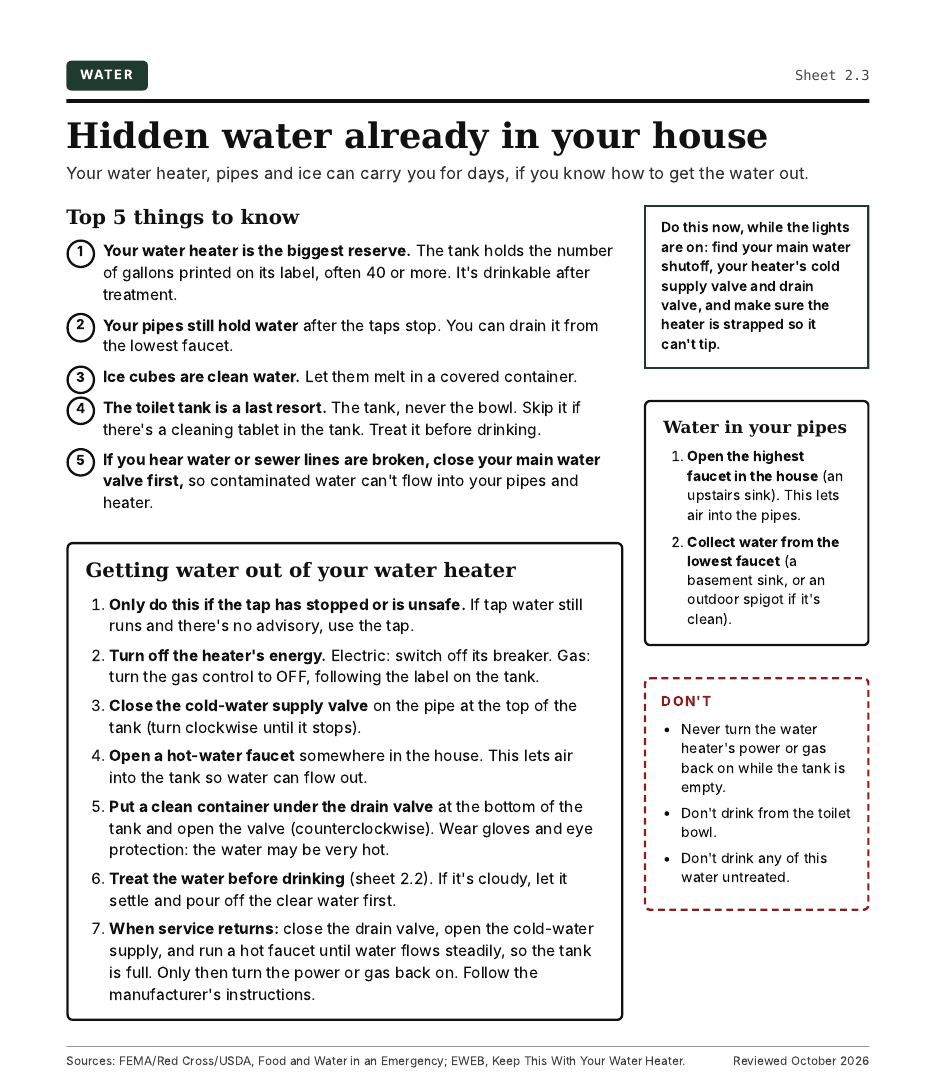
Can I drink the water in my water heater?
Yes, once you treat it. Most tanks hold 40 gallons or more, which is a lot of drinking water for a family. Getting it out takes seven steps, and turning the heater back on while the tank is empty can ruin it.
Guide sheet 2.3 · Hidden water already in your house
How long is the meat in my fridge good?
About 4 hours with the door shut. After that, throw out anything that's been above 40°F. A full freezer lasts about 48 hours, a half-full one about 24.
Guide sheet 3.1 · Is the food in the fridge still safe?
How much bleach makes water safe to drink?
8 drops of plain 6% bleach per gallon of clear water, then wait 30 minutes. It should smell slightly of chlorine. Cloudy or very cold water needs twice as much.
Guide sheet 2.2 · Making water safe to drink
Can I flush the toilet with no running water?
Yes. Pour about a gallon of water into the bowl in one fast, continuous pour. Use bathtub water, not drinking water.
Guide sheet 8.1 · Flushing without running water
Is the generator OK in the garage with the door open?
No. Run it outdoors, at least 20 feet from windows, doors and the garage. Carbon monoxide from portable generators killed 765 people in the U.S. from 2009 to 2019.
Guide sheet 6.1 · Carbon monoxide
Can I heat the house with my gas oven?
No. Never heat your home with a gas stove, oven, grill or clothes dryer. The guide covers what does work, room by room.
Guide sheet 5.1 · Staying warm without power
Will my debit card work if hackers take down the grid?
Probably not where you shop. Card readers, ATMs and gas pumps all need power and a working network. Keep some cash in small bills and your car above half a tank. Your money is still in the bank: FDIC insurance covers up to $250,000 per depositor, per bank, per ownership category.
Guide sheet 10.1 · Money when cards and ATMs don't work
Phones are down. How do I reach my family?
Text instead of calling. Short texts often get through when calls won't. Pick one relative in another state that everyone checks in with, and two meeting spots: one outside your home, one outside your neighborhood.
Guide sheet 9.1 · Reaching family when phones are down
Should I call 911 to ask when the power's coming back?
No. Call 911 only for a life-threatening emergency. A battery or hand-crank radio gets you updates without a phone.
Guide sheet 1.1 · The first hour without power
The guide has nearly 40 sheets like these, each with the five things to know, step-by-step instructions and what not to do.
Free: the Lights Out Checklist
One printable page for any long outage, from an ice storm to a grid cyberattack: what to do before, during and after, and what never to do. Stick it on the fridge and share it with anyone.
A real page from the guide
What's in your guide
A plan for your home
Your top gaps, a shopping list with three tested picks per item at different prices, your local risks, and when to leave. Built from your answers.
Nearly 40 how-to sheets
Water, food, power, heat, safety, health, sanitation, communication, money, kids and pets, plus the storms most likely where you live.
Pages you complete
Contacts, medications, where your shutoff valves are, and wallet cards for everyone in the house.
Product picks come from independent reviewers who test them, such as Popular Science, Bob Vila, Outdoor Life and CleverHiker, and are checked every quarter.
Why people are getting ready now
For more than two years, federal agencies have warned that foreign hackers are inside parts of America's power and water systems. Add aging equipment and bigger storms, and long outages are no longer rare.
How long Chinese state hackers kept access inside some U.S. critical-infrastructure networks, including energy and water, according to CISA, the FBI and the NSA (source)
CISA warned that Iran-affiliated hackers were tampering with control equipment used in power and water systems (source)
Texans who lost electricity, for days, in the February 2021 freeze. The storm was linked to 246 deaths (source)
No one can tell you whether a cyberattack will cut your power, or when. A long outage looks the same at your house whatever caused it: no heat or air conditioning, no fridge, maybe no water, no internet, no card readers. The guide covers all of it, including what changes when it's a cyberattack: cash, phones, news and scams.
Most households don't need a bunker. They need to get through a few days without power, or a week of empty shelves.
The reference sheets
How it works
- Answer about 20 quick questions and pay. About 4 minutes: your ZIP code, your home's heat and water, who lives there, and what you already have.
- Get your guide by email, usually within minutes, as a PDF. If you choose the printed edition, a coil-bound color copy also arrives by mail in about 3 weeks.
- Put it somewhere you can find in the dark. Print the PDF or use your printed copy. A second copy in the car helps. Update it once a year, or after a move or a new baby.
What it isn't
- Not wiring, gas or installation advice. Anything like that goes to a licensed pro.
- Not medical advice. For medicine, the guide tells you what to ask your pharmacist.
- Not a subscription.
- Not fear. No bunkers, no doomsday kits.
Get your guide
$39 for the PDF, or $69 for the PDF plus a printed, coil-bound copy mailed to you (shipping included, US addresses only). One-time. Each guide is made for your household, so all sales are final.
Start the questionsTerms of Service
By buying a guide you agree to these terms. Last updated November 22, 2026.
- General information only. A Ready Enough guide is general educational information about household preparedness. It is not professional advice of any kind, including electrical, gas, HVAC, plumbing, structural, medical, legal or financial advice. For any of those, consult a licensed professional.
- No guarantee. The household section of each guide is generated with AI from your answers, and any part of a guide may contain errors or omissions. We do not guarantee that a guide is complete, accurate or suitable for your home, or that following it will prevent injury, loss or damage. Check anything important before you act on it.
- Your decisions are yours. You decide what to buy, install, store or do. Follow manufacturer instructions, local building and fire codes, and official emergency guidance. Never run a generator, grill or fuel-burning heater indoors or in a garage, and keep working carbon monoxide alarms.
- Products and sellers. Ready Enough does not make, sell, install or warrant any product. Any purchase is between you and the seller, and the seller's terms and warranties apply. Some links may earn us a commission; this never changes the price you pay.
- Not an emergency service. In an emergency, call 911 and follow instructions from local officials.
- Limitation of liability. To the fullest extent the law allows, Ready Enough is not liable for any indirect, incidental, special or consequential damages, or for any loss arising from a purchase you make or don't make, or any action you take or don't take, based on a guide. Our total liability for any claim relating to a guide is limited to the amount you paid for it.
- Printed copies. Printed copies are made to order and ship by mail to US addresses only, usually arriving in about 3 weeks. Your PDF arrives by email right away either way.
- All sales are final. Each guide is made to order for your household, so we don't offer refunds.
- Governing law. These terms are governed by the laws of North Carolina.
- Contact. readyenough1@gmail.com